

Recombinant Human TNF-alpha Protein
- 100 μg
DESCRIPTION | ||
Gene Name Synonym | Tumor Necrosis Factor, TNFA, TNFSF2, Cachectin, Cytotoxin, Differentiation-inducing factor, DIF | |
Species | Human | |
Accession | P01375 | |
Source | E.coli | |
SPECIFICATIONS | ||
Amino acid sequence | E.coli-derived Human TNFα protein,Val77-Leu233. | |
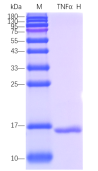
Molecular Weight | Approximately 17.0 kDa. | |
Purity | >98.0% as determined by SDS-PAGE. | |
Endotoxin | <1.0 EU/μg of the protein by the LAL method. | |
Formulation | Lyophilized from sterile Tris-Hcl, pH 8.0. Normally 5%-8% trehalose and mannitol are added as protectants before lyophilization. | |
Reconstitution | Dissolved in sterile water, it is recommended to add 0.1% HSA or BSA for long-term preservation. | |
STORAGE | ||
Stability and Storage | 12 months from date of receipt at -20°C to -70°C. After reconstitution, it is stable at 4°C for 1 week or -20°C for almost 6 months (with carrier protein). It is recommended to freeze aliquots at -20°C or -80°C for extended storage. | |
BACKGROUND | ||
Tumour Necrosis Factor alpha (TNF alpha) is a potent pro-inflammatory cytokine, also known as cachectin, is a polypeptide cytokine produced by monocytes and macrophages. TNF alpha exists in two forms; a type II transmembrane protein (tmTNF-α) and a mature soluble protein (sTNF-α). TNF alpha binds to its receptors, mainly TNFR1 and TNFR2, and then transmits molecular signals for biological functions such as inflammation and cell death. Both sTNF-α and tmTNF-α activate TNFR1, and process a death domain (DD) that interacts with the TNFR1-associated death domain (TRADD) adaptor protein. The TNFR2 signaling pathway is mainly activated by tmTNF-α. TNFα receptor signaling can simultaneously activate caspase 8, the transcription factor, NF-κB and the kinase, JNK. TNF alpha stimulates NF-κB pathway via TNFR2 promotes cancer growth, invasion, and metastasis.The amino acid sequence of human TNF alpha protein has low homology between mouse, rat, bovine TNF alpha protein. While, human TNF alpha shares 94.85% aa sequence identity with cynomolgus TNF alpha protein, mouse TNF alpha shares 94.47% aa sequence identity with rat TNF alpha protein. | ||
Data | ||
SDS-PAGE | Bioactivity | |
|
| |
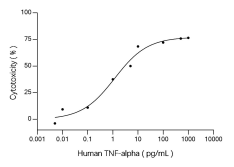
Recombinant Human TNFα Protein was determined by SDS-PAGE with Coomassie Blue. | Measured in a cytotoxicity assay using L929 mouse fibrosarcoma cells in the presence of the metabolic inhibitor actinomycin D. The ED50 for this effect is typically 0.03-0.15 ng/mL. | |
仅供科研用途,不可用于临床诊断!
| 货号 | 名称 | 规格 | 价格 | 操作 |
|---|
| 货号 | 名称 | 规格 | 价格 | 操作 |
|---|
